
Flat Roof vs. Pitched Roof: What Southern California Homeowners Should Know
If your Downey property has both a pitched, shingled main roof and a flat or low-slope section over a garage, addition, or patio cover, which describes a large share of homes in this city, you’ve probably noticed the two sections don’t seem to age or fail the same way. That’s not a coincidence. Flat and pitched roofs are fundamentally different systems, with different failure patterns, different diagnostic approaches, and different maintenance needs.
Here’s what actually differs between the two, and why treating a flat roof leak the way you’d treat a pitched roof leak is one of the most common reasons a repair doesn’t hold.
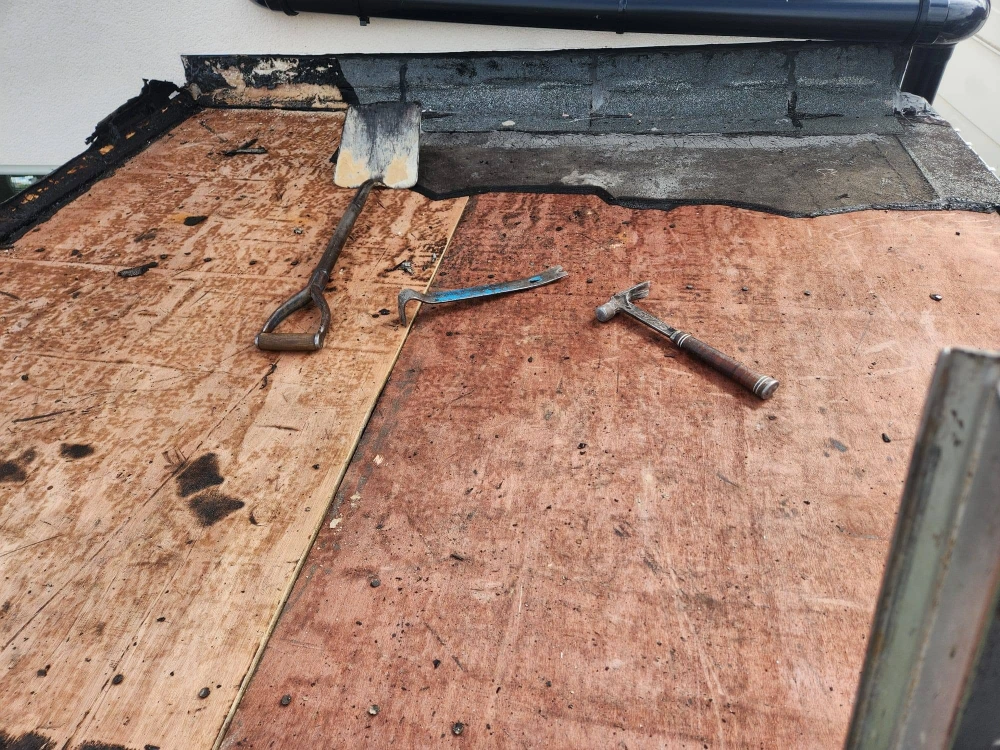
Why Gravity Works Differently on Each
On a pitched roof, gravity does a lot of the diagnostic work for you. Water generally travels straight down from wherever it enters, which means the interior leak location is a reasonably good indicator of where the problem is on the roof directly above it. Pitched roof leaks are also more commonly caused by damaged shingles or tiles themselves, the field material, rather than transition points.
On a flat roof, that relationship breaks down almost entirely. Water travels laterally along the deck and underneath the membrane before it finds an exit point, sometimes 15 to 20 feet from where it actually entered. This is why the interior stain and the actual roof-level failure are so often in completely different spots. We cover this specific mechanism in our guide on how water travels beneath a membrane.
Where Each Type Actually Fails
Flat roof leaks are disproportionately caused by transitions and penetrations, parapet walls, flashing, pipe boots, skylight curbs, rather than failures in the open field of the membrane. Pitched roofs fail differently: damaged or missing shingles, cracked tiles, and flashing at valleys and chimneys are the most common culprits, though the open field of the roofing material itself is a more common failure point than it is on flat roofs.
Our leak causes guide breaks down the full list of flat roof failure points in detail, and it’s worth understanding if you’re trying to diagnose which category your specific leak falls into before calling anyone.

Diagnostic Approach: Why One Size Doesn’t Fit All
This is the part that actually matters for getting a leak fixed correctly. Diagnosing a flat roof the way you’d diagnose a pitched roof, looking straight up from the interior stain and assuming that’s the problem spot, often leads to the wrong conclusion and a repair that doesn’t stop the leak.
A properly diagnosed flat roof leak starts by tracing the stain back to a general location, then checking every nearby transition (walls, penetrations, seams) before assuming anything about the exact failure point. This is a fundamentally different process than pitched roof diagnosis, which is part of why specializing specifically in flat roofing, rather than treating it as a side service alongside general roofing, leads to more accurate diagnoses.
Lifespan and Maintenance Differences
Both roof types can last decades with proper maintenance, but the maintenance itself looks different. Flat roofs need drainage checked regularly, since standing water is a flat-roof-specific risk that simply doesn’t apply the same way to a sloped surface. Pitched roofs need periodic checks for damaged or missing shingles and valley flashing condition, but drainage generally isn’t the same concern since water sheds off naturally.
See our flat roof lifespan by material guide for specifics on how long different flat roofing systems typically last, which varies more by material choice than pitched roofing does.
If Your Property Has Both Roof Types
Many Downey homes have exactly this situation: a pitched, shingled main house with a flat or low-slope addition, garage, or patio cover. If you’re not sure which type is actually leaking, or you’re getting mixed signals, that’s worth clarifying before assuming either diagnostic approach applies.
We handle both flat and sloped roof repairs, but flat and low-slope roofing specifically is where our deepest expertise applies. If you have a mixed-roof property with a leak somewhere, we’ll help you figure out which system is actually the source before recommending anything.
Frequently Asked Questions
Is a flat roof less durable than a pitched roof?
Not inherently. Both can last decades with proper installation and maintenance. Flat roofs face different specific risks (ponding water, transition failures) rather than being categorically less durable.
Can the same contractor handle both flat and pitched roof repairs?
Many can, but the diagnostic skill set genuinely differs between the two. It’s worth asking specifically about flat roof experience if that’s the section that’s leaking.
Why does my flat roof section seem to need more attention than my main roof?
This is common, especially on older properties, since flat sections often have more transitions relative to their size (walls, penetrations) and are more sensitive to drainage issues than a sloped roof shedding water naturally.
Is it worth converting a flat roof section to a pitched one?
This is a significant structural project, not a typical repair or replacement decision, and depends heavily on your specific property’s design. Worth a dedicated conversation if you’re considering it.
Not Sure Which Roof Section Is Actually Leaking?
We’ll help you pinpoint the source, whether it’s your flat section or your main roof.



2 Comments