Why Downey’s Mid-Century Homes Are Especially Prone to Flat Roof Leaks
If you own a home in Downey and you’ve never had your flat roof section looked at, there’s a reasonable chance it’s original, or close to it. The median Downey home was built around 1959, and roughly two-thirds of the city’s housing stock dates to the 1940s through 1960s construction boom. That’s not just a historical fact, it’s the single biggest reason flat roof leak calls are as common as they are in this specific city.
Here’s the real story behind why Downey’s housing stock creates such a predictable pattern of flat roof problems, and what it means for your specific property.
The Original Construction Problem
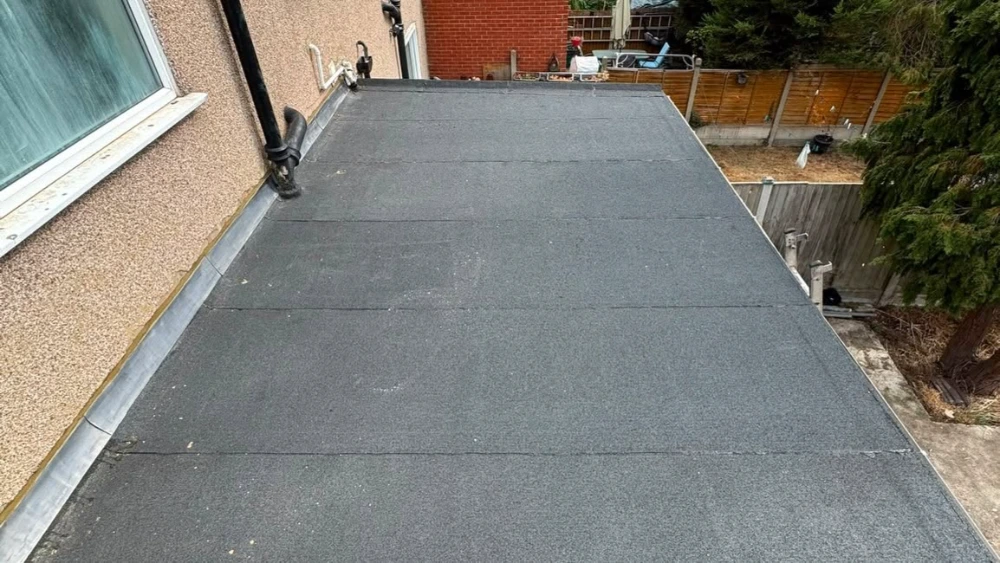
A large share of Downey’s postwar homes carry a flat or low-slope roof section somewhere on the property, a garage, a laundry room addition, a patio cover, sometimes an entire mid-century ranch wing built with a low-slope design. Many of these sections were originally built-up roofing (BUR), layers of felt and tar, sometimes topped with gravel.
That system was never engineered to last 65 to 80 years without significant maintenance or re-covering. Yet a meaningful number of these original sections are still in place today, either untouched or recovered once, decades ago, and quietly aging well past any reasonable service expectation.
The Climate Compounds the Age Problem
Downey’s specific climate pattern, long, hot, dry summers followed by a comparatively short but sometimes intense wet season, creates a stress cycle that’s harder on flat roofs than more evenly distributed rainfall would be. Summer UV exposure quietly degrades membrane surfaces and dries out sealants over months, with no visible sign of damage. Then the first significant rain of the season tests every weak point that summer created, all at once.
Daily thermal cycling adds to this. Roof surface temperatures can swing from cool overnight lows to well over 100°F in direct summer sun, and that expansion and contraction works fasteners loose and stresses seams and flashing continuously, independent of any single storm event.

Why Original BUR Sections Are Particularly Vulnerable Now
Built-up roofing systems from the 1950s and 60s are, by any reasonable standard, past their expected service life today. Original modified bitumen recovers done decades ago are approaching the same point. This doesn’t mean every original roof section is actively failing, some have been well-maintained and are still sound, but it does mean the margin for error has shrunk considerably.
A small issue that a newer roof might tolerate for years, a slightly worn pipe boot, a minor seam gap, is more likely to become an active leak on an original 1950s BUR section simply because there’s less remaining material integrity to absorb that kind of wear.
What This Means for Your Specific Property
If your home dates to Downey’s original construction boom and you’re not sure when your flat roof sections were last inspected, or recovered, that’s genuinely worth checking, even without an active leak right now. A proactive inspection ahead of the rainy season is the single best-timed check you can schedule if it’s been years, or you’re honestly not sure.
We cover the full technical picture, including material selection, drainage design, and ventilation considerations specific to this housing stock, in our detailed guide on why Downey’s mid-century homes develop flat roof leaks.
Newer Additions Aren’t Automatically Exempt
It’s worth noting this pattern isn’t limited to strictly original construction. Additions and recovers done at various points over the following decades carry their own age-related wear, just on a different timeline. If your home has had a flat roof section replaced or recovered at some point, that section is aging on its own clock, separate from whatever’s original.
Whatever the age of your specific flat roof section, understanding this broader pattern helps explain why Downey specifically generates so many of these calls, and why proactive checking matters more here than it might in a city with a newer housing stock.
Frequently Asked Questions
How do I know if my flat roof section is original to the house?
Property records, prior inspection reports, or simply asking during a professional inspection can usually determine this. If you’ve owned the home a long time without any roof work done, it’s reasonably likely to be original or a single past recover.
Does an old roof automatically need full replacement?
No. Age alone doesn’t determine repair versus replacement. A well-maintained older roof can often still be repaired; condition matters more than calendar age. See our repair vs. replacement guide.
Are Downey’s neighborhoods equally affected by this pattern?
The concentration of original mid-century construction varies somewhat by neighborhood. Areas like North Downey with more original ranch-style construction tend to have a higher share of aging original flat-roof sections.
Should I get my roof checked even without any signs of a leak?
Yes, especially given this housing stock’s age profile. A proactive inspection, ideally in late summer before the rainy season, catches developing issues before they become active leaks.
Not Sure How Old Your Flat Roof Section Is?
A free inspection will tell you exactly what condition it’s in.


